Hand vs Machine Embroidery: Cost, Look and Lead Time Compared
Buyers deciding between hand vs machine embroidery are really choosing between two different trade-offs — hand embroidery gives dimensional, one-of-a-kind texture at a higher cost and longer lead time, while machine embroidery gives consistent, repeatable results faster and cheaper at volume. Neither is “better” on its own; the right choice depends on the design, the order size, and the budget. Here’s how the two actually compare, with the real minimums and lead times behind each.
On this page
How hand and machine embroidery look
The clearest way to think about hand vs machine embroidery is by what the finished surface actually looks and feels like. Hand embroidery — needlework, bead work, sequin work, zari and zardozi-style metallic thread — builds up raised, dimensional texture one stitch at a time, and because it’s done by hand, no two pieces are ever perfectly identical, which reads as a deliberate, artisanal quality rather than a flaw. Embroidery done by hand can also combine techniques (beading alongside thread work, for instance) in ways that are slow or impossible to digitize.
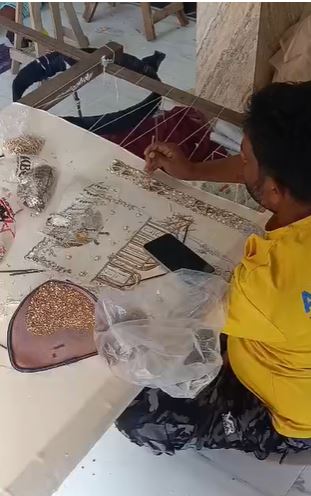
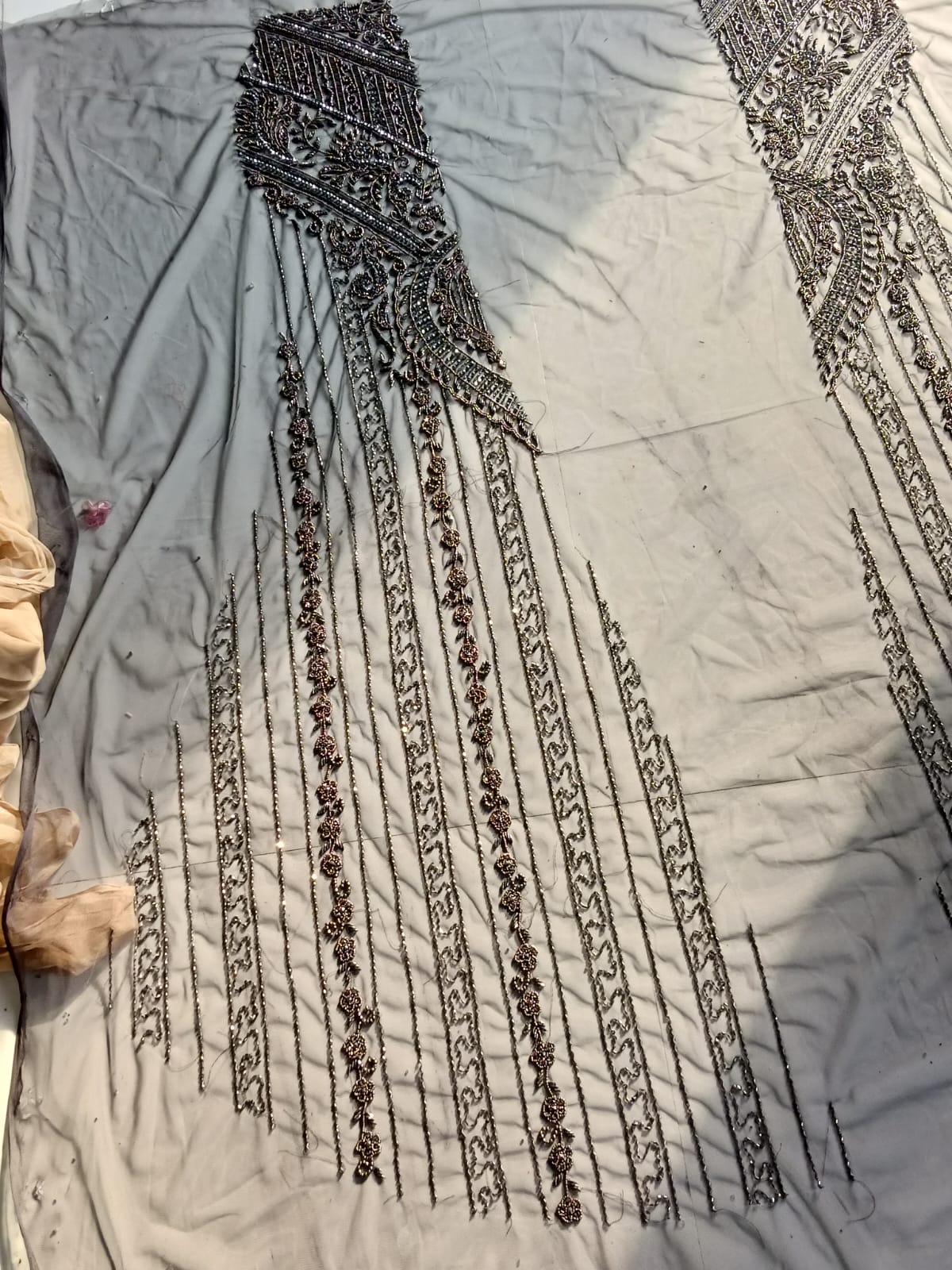
Hand embroidery in progress on a wooden frame, and the finished beadwork detail it produces.
Machine embroidery is digitized first — a design is converted into a stitch file, then run on an embroidery machine — which gives perfectly even stitch density and exact repeatability across every piece in an order. It suits clean, repeat-pattern motifs, logos, and borders, and it reads as more uniform and commercial rather than one-off.
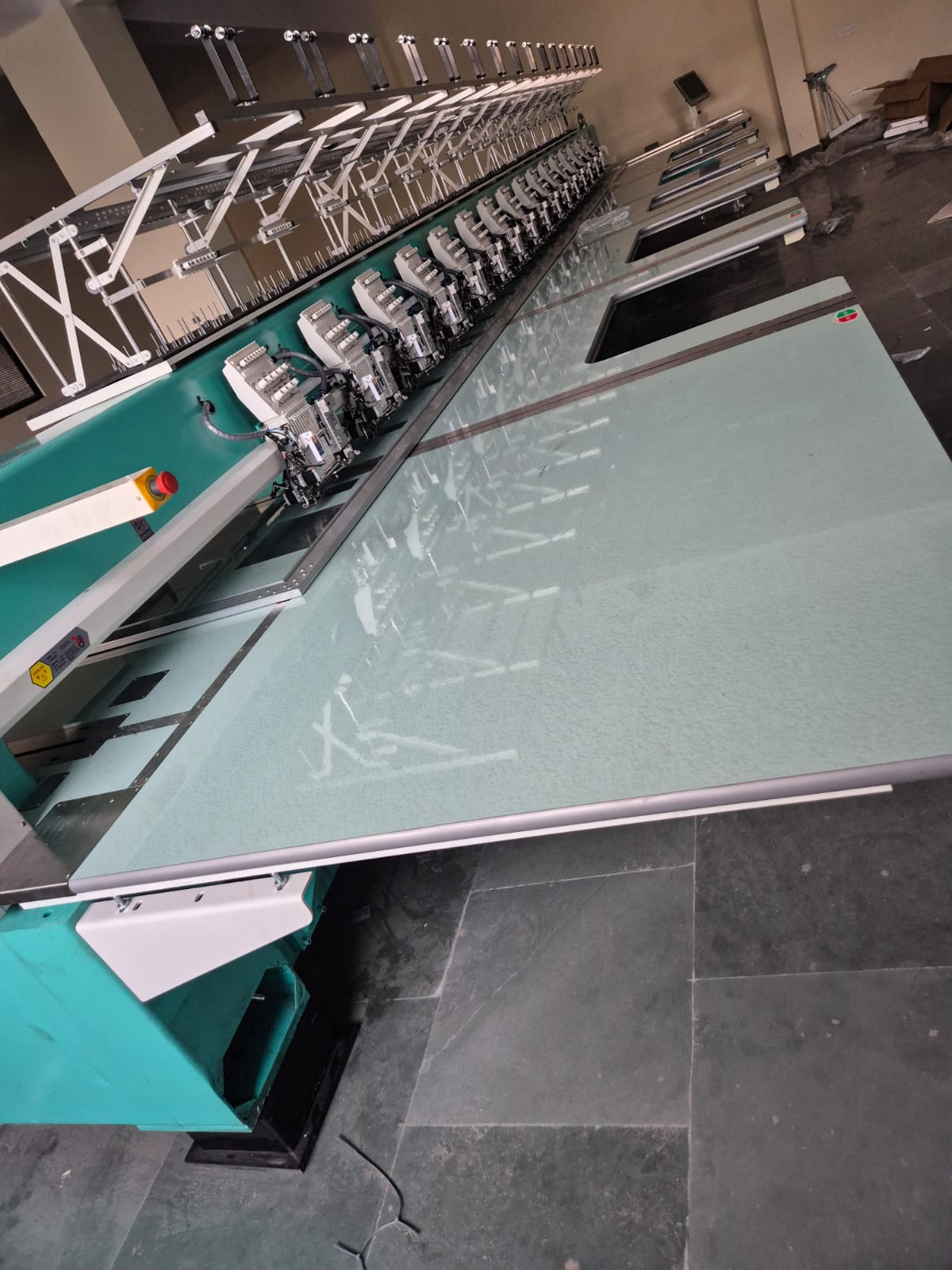
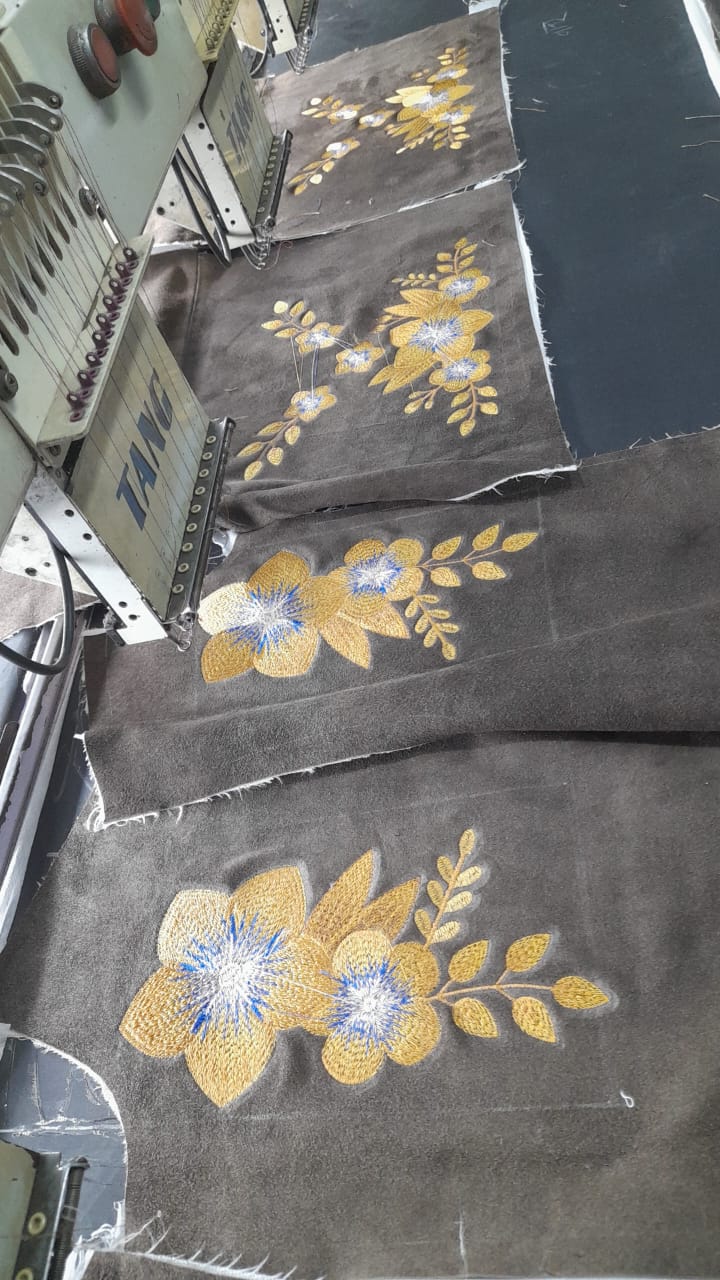
A multi-head embroidery machine, and the repeat floral motifs it stitches out.
Cost differences
Cost is usually the deciding factor in hand vs machine embroidery once a buyer has settled on a look. Hand embroidery is priced largely on artisan hours — a dense, heavily beaded motif can take a skilled embroiderer several days per piece, so cost scales close to linearly with order size and design density. Machine embroidery carries a one-time digitizing cost to create the stitch file, but after that, running the design is fast and the per-piece cost drops sharply as volume goes up, which is why it’s the more economical choice for larger, simpler, repeat-motif orders.
Lead time differences
Lead time follows the same logic. Hand-embroidery-only production starts at a minimum of 20 pieces per style with a typical lead time of 4–5 weeks, since every piece is worked individually and artisan capacity is limited per week. General embroidered production (machine-assisted or combination work) starts at 30 pieces per style with a 4–6 week lead time, while a plain, unembroidered run starts at 50 pieces in 3–4 weeks — see what MOQ actually means for how these minimums work across styles, sizes and colourways. A first sample, hand or machine, typically takes 7–10 days either way.
Durability and care
Heavily beaded or sequinned hand embroidery is generally more delicate in everyday wear and benefits from gentler handling and dry cleaning, since the embellishment sits proud of the fabric and individual beads or threads can catch. Machine embroidery’s tighter, more uniform stitch density tends to hold up better to repeated washing and regular wear, which is one reason it’s often the better fit for commercial basics and resortwear that customers will wash often rather than one special-occasion piece.
Which to choose for your piece
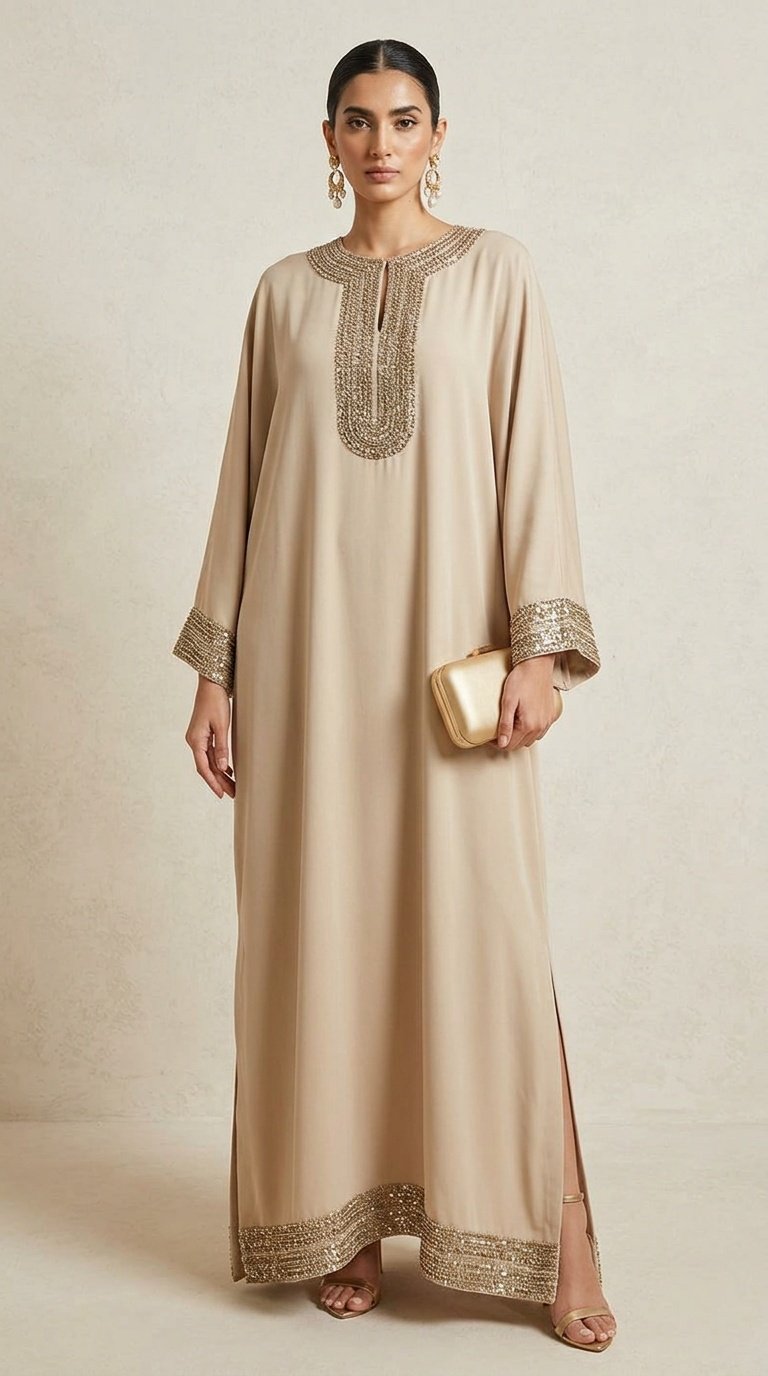
For a signature piece, a small capsule, or anything where the embroidery itself is the main selling point, hand embroidery usually wins on look even at a higher cost — this is the technique behind most of the kaftan and abaya embroidery work we do. For larger, repeat-pattern orders, logo placement, or budget-sensitive production, machine embroidery gets a consistent result faster. Many of our orders actually combine both — machine embroidery for a repeat border or motif, hand finishing (beading, sequins) for a focal point. If you’re not sure which fits your design and budget, these are the questions worth asking first.
Minimums and lead times
Minimums are counted per style, not per order, so a run can be split across sizes and colourways either way.
| Stage | Minimum per style | Typical lead time |
|---|---|---|
| First sample | 1 piece | 7–10 days |
| Production, plain | 50 pieces | 3–4 weeks |
| Production, embroidered (machine or combination) | 30 pieces | 4–6 weeks |
| Hand embroidery only | 20 pieces | 4–5 weeks |
The short version
Hand vs machine embroidery, in one line: hand embroidery costs more and takes longer but gives one-of-a-kind, dimensional texture; machine embroidery is faster and cheaper at volume with perfectly consistent repeats. Send us your design to get a quote for either, or browse more garment manufacturing insights.